Notta vs. Transkriptor: Which One to Choose?
Notta vs. Transkriptor: Which One to Choose?aNotta suits teams needing real-time transcription for Zoom, Teams, Meet, and Webex, with speaker labels and AI summaries. Transkriptor offers higher accuracy, more languages, broader formats, and wider use cases, helping you choose what best fits your workflow.

- Notta vs. Transkriptor Comparison for Accuracy
- Notta vs. Transkriptor Comparison for Speed
- Notta vs. Transkriptor Comparison for Language Support
- Notta vs. Transkriptor Comparison for Speaker Identification
- Notta vs. Transkriptor Comparison for Noise Handling
- Notta vs. Transkriptor Comparison for Punctuation Quality
- Notta vs. Transkriptor Comparison for File Format Support
- Notta vs. Transkriptor Comparison for Platform Availability
- Notta vs. Transkriptor Comparison for Integration Options
- Notta vs. Transkriptor Comparison for Team Collaboration
- Notta vs. Transkriptor Comparison for Export Options
- Notta vs. Transkriptor Comparison for Security and Privacy
- Notta vs. Transkriptor Comparison for Pricing
- Notta vs. Transkriptor Comparison for User Interface and Ease of Use
- Notta vs. Transkriptor Comparison for YouTube Transcription Capability
- Notta vs. Transkriptor Comparison for Call and Meeting Transcription
- Notta vs. Transkriptor Comparison for Offline or Online Processing
- Notta vs. Transkriptor Comparison for API Availability
- Notta vs. Transkriptor Comparison for Model Quality
- Notta vs. Transkriptor Comparison for Context Understanding
- Which One is Better for Reporters: Notta vs. Transkriptor?
- What are the Advantages of Transkriptor Compared to Notta?
- What are the Advantages of Notta Compared to Transkriptor?
- Notta vs. Transkriptor Comparison for Accuracy
- Notta vs. Transkriptor Comparison for Speed
- Notta vs. Transkriptor Comparison for Language Support
- Notta vs. Transkriptor Comparison for Speaker Identification
- Notta vs. Transkriptor Comparison for Noise Handling
- Notta vs. Transkriptor Comparison for Punctuation Quality
- Notta vs. Transkriptor Comparison for File Format Support
- Notta vs. Transkriptor Comparison for Platform Availability
- Notta vs. Transkriptor Comparison for Integration Options
- Notta vs. Transkriptor Comparison for Team Collaboration
- Notta vs. Transkriptor Comparison for Export Options
- Notta vs. Transkriptor Comparison for Security and Privacy
- Notta vs. Transkriptor Comparison for Pricing
- Notta vs. Transkriptor Comparison for User Interface and Ease of Use
- Notta vs. Transkriptor Comparison for YouTube Transcription Capability
- Notta vs. Transkriptor Comparison for Call and Meeting Transcription
- Notta vs. Transkriptor Comparison for Offline or Online Processing
- Notta vs. Transkriptor Comparison for API Availability
- Notta vs. Transkriptor Comparison for Model Quality
- Notta vs. Transkriptor Comparison for Context Understanding
- Which One is Better for Reporters: Notta vs. Transkriptor?
- What are the Advantages of Transkriptor Compared to Notta?
- What are the Advantages of Notta Compared to Transkriptor?
Notta focuses on real-time meeting intelligence. It joins Zoom, Google Meet, Teams, and Webex calls, transcribes live, and generates structured AI notes with visual summaries through Notta Brain while syncing data to your CRM.
Transkriptor takes a broader and more flexible approach. It supports bot-based meeting capture and batch uploads for audio or video files, works across 100+ languages, and exports in multiple formats, making Transkriptor useful beyond meetings.
This guide compares Notta vs. Transkriptor across key categories to help you choose the right tool for sales calls, lectures, legal recordings, or content production.
Notta vs. Transkriptor Comparison for Accuracy
Notta delivers up to 98% accuracy across 58 supported languages, and it performs well in clear audio conditions. However, accuracy can drop when accents are strong or when speakers overlap.
Transkriptor achieves up to 99% accuracy with advanced speech models, enabling it to handle multiple speakers and background noise more effectively. While the 1% gap may seem small, it results in fewer errors in complex recordings.
| Feature | Notta | Transkriptor |
|---|---|---|
| Word accuracy | 98%+ accuracy in standard audio conditions | Up to 99% accuracy across varied recording conditions |
| Accent handling | Accuracy drops noticeably with heavy regional accents | Handles diverse accents and dialects confidently across all 100+ languages |
| Technical terms | Custom vocabulary available in English and Japanese only | Recognizes complex technical, medical, and legal terminology across all supported languages |
| Long audio accuracy | Handles standard meeting lengths well; longer files may drift slightly | Processes files of any length without accuracy loss |
| Noisy environment | Relies on platform audio quality; no independent noise filter | Applies active noise suppression during transcription to preserve speech clarity |
| Real-time accuracy | Transcribes live during meetings in real time | Transcribes after the meeting ends |
| Multi-speaker accuracy | Auto-identifies speakers with audio-based diarization during live calls | Transcribes multiple speakers and supports global label renaming across the full transcript |
| Contextual understanding | Identifies key decisions, action items, and insights via Notta Brain | Transcribe even um, ohh, and small pauses correctly |
Verdict: Transkriptor's 99% accuracy and noise suppression reduce manual editing time. Notta performs well and achieves 98% accuracy on clean meeting audio, but struggles with technical vocabulary outside English and Japanese, as well as in challenging recordings.
Notta vs. Transkriptor Comparison for Speed
Notta processes one hour of uploaded audio in less than 15 minutes. That makes it one of the fastest options for file-based workflows. It also transcribes live during meetings, which adds another clear speed advantage.
Transkriptor does not offer real-time transcription. It completes post-meeting processing at approximately 50% of the recording's original duration, which still beats most tools for file uploads.
| Feature | Notta | Transkriptor |
|---|---|---|
| Upload speed | Fast intake across all accepted file types | Handles file intake efficiently across 20+ formats |
| Processing speed | Takes around 15 minutes | Roughly 50% of the file’s total duration |
| Real-time speed | Yes, live transcription runs during the meeting | Not available in any plan |
| Large file handling | Accepts files up to 10GB and 5 hours on paid plans | Manages large files without degraded performance |
| Batch processing speed | Runs multiple file uploads simultaneously | Processes batch uploads in parallel queues |
| Export speed | The transcript and summary will be ready shortly after the meeting ends | Output available for download immediately after processing |
Verdict: Notta takes an edge in this category cleanly. Live transcription and fast file processing gives it a speed advantage against Transkriptor. Transkriptor is still quicker than many competitors for file-based work, but Notta sets a higher bar here.
Notta vs. Transkriptor Comparison for Language Support
Language coverage determines whether a tool is genuinely global or just global-ish. Notta supports 58 languages for transcription and offers a bilingual feature as a paid add-on that allows two languages to run side by side in the same session. That comfortably covers a lot of the world's major business languages.
Transkriptor doubles that language library. Its 100+ language offering includes transcription and translation, along with custom vocabulary. If your team regularly records content in Turkish, Hindi, Dutch, or Arabic, Transkriptor does work that Notta simply cannot.
| Feature | Notta | Transkriptor |
|---|---|---|
| Number of supported languages | 58 languages, bilingual add-on covers 23 language pairs | 100+ languages for both transcription and translation |
| Automatic language detection | Detects the spoken languages automatically before transcribing | Auto-identifies languages at the start of each file or session |
| Multilingual transcription | Bilingual add-on captures two languages in parallel | Handles multilingual content across its full 100+ language catalog |
| Accent coverage | Accuracy weakness with heavy or uncommon regional accents | Manages regional variation consistently across all supported languages |
| Dialect recognition | Covers common dialects; narrower on regional variation | Recognizes dialects in Arabic, Spanish, Chinese, and other major languages |
| Punctuation in different languages | Applies correct punctuation across its 58 languages | Adjusts punctuation rules to match each language’s grammar structure |
Verdict: Transkriptor is the clear winner for any team working across more than a handful of languages. Notta covers the basics well. Once content moves beyond its 58+ language range, Transkriptor becomes the only practical option.
Notta vs. Transkriptor Comparison for Speaker Identification
Both tools, Notta and Transkriptor, tag speakers automatically, but they handle it in small ways that matter at scale. Notta assigns numbered labels during live calls. You rename them manually afterward. It works fine for a weekly team standup. It gets tedious fast when you are processing dozens of recorded interviews.
Transkriptor assigns the same numbered labels and provides one-click global renaming. Change a label once, and it updates throughout the entire transcript. That single feature saves meaningful editing time on longer recordings.
| Feature | Notta | Transkriptor |
|---|---|---|
| Number of speakers detected | Handles typical meeting participant counts through diarization | Distinguishes multiple speakers even in recordings with heavy crosstalk |
| Accuracy of speaker separation | Reliable in small meetings; less consistent in larger or noisier sessions | Maintains accurate separation across varied group sizes and audio sources |
| Speaker labeling | Numbered labels applied during transcription; rename manually after the meeting ends | Numbered labels applied; one global rename action updates the full transcript |
| Real-time speaker detection | Tags speakers during live transcription | Tags speakers during post-meeting processing |
| Multi-speaker overlap | Loses accuracy when participants interrupt or talk simultaneously | Segments overlapping speech more cleanly for clearer attribution |
Verdict: Transkriptor is better for complex audio because it handles overlapping speakers and large recordings with higher accuracy, while Notta is a solid choice for small meetings where speaker tagging works well and the setup is simple.
Notta vs. Transkriptor Comparison for Noise Handling
Notta's noise handling begins and ends at the meeting platform. Whatever Zoom or Teams deliver after their own processing, that is what Notta works with. There is no second filter. When audio conditions are poor, the transcript reflects the same.
Transkriptor builds noise suppression directly into its transcription process. It does not rely on whatever the recording source did first. That independent layer makes a real difference for field recordings, in-person captures, or any situation where the original audio was not pristine.
| Feature | Notta | Transkriptor |
|---|---|---|
| Background noise reduction | Entirely dependent on the meeting platform’s own processing | Runs active noise filtering inside its own transcription pipeline |
| Accuracy in noisy environments | Degrades when the source audio contains significant background sound | Built to extract speech clearly from challenging audio conditions |
| Wind noise handling | No dedicated wind filter exists | Separates voice frequencies from wind interference effectively |
| Traffic or crowd noise handling | Struggles when competing sounds reach the speaker's volume | Algorithms isolate the primary speaker from background crowd noise |
| Microphone quality | Transcript quality tracks very closely to device input quality | Enhances speech clarity from lower-quality microphone inputs |
| Echo and reverb handling | Relies on platform-level echo cancellation | Focuses on producing clean text output from reverb-affected audio |
Verdict: Transkriptor is better suited to recordings in uncontrolled environments, making it a good fit for journalists and researchers working in the field. Meanwhile, Notta works well for teams in online meetings where audio is clear, but it struggles when audio quality drops.
Notta vs. Transkriptor Comparison for Punctuation Quality
Punctuation quality separates a usable transcript from one that needs a full editing pass. Transkriptor reads natural speech patterns, pauses, clause breaks, sentence rhythm, and applies punctuation that makes the output ready to share with minimal editing. Notta does solid work, too. Its 58-language punctuation output reads cleanly for meeting notes and team summaries.
| Feature | Notta | Transkriptor |
|---|---|---|
| Punctuation accuracy | Consistent and accurate across all 58 supported languages | Applies strong punctuation across all 100+ languages |
| Sentence segmentation | Break speech into clear sentences based on natural pause detection | Identifies sentence boundaries naturally from speech rhythm and pacing |
| Manual correction Speed | Light touch needed for clean recordings; heavier work for complex audio | Lower error rate means users spend less time correcting before sharing |
| Formatting customization | Output is standardized for meeting summaries and AI notes | Supports H1, H2, and H3 heading structure for document style formatting |
Verdict: If you want document-ready transcripts with minimal editing, Transkriptor is the better choice, while if you just need clean notes for internal use, Notta works well enough.
Notta vs. Transkriptor Comparison for File Format Support
Format support matters at both ends: what you can bring in and what you can get as output. Notta accepts a solid range of audio and video types on the input side. On the export side, it adds XLSX to the usual document formats, which is genuinely useful for data-heavy workflows. Transkriptor counters with VTT export for web video, which Notta lacks entirely.
| Feature | Notta | Transkriptor |
|---|---|---|
| Supported import formats | WAV, MP3, M4A, OGG, WMA, MP4, AVI, MOV, WEBM, and others | Works seamlessly with meeting tools and 20+ formats covering most audio and video file types, such as OGG, FLAC, WMA, and AVI |
| Text export options | TXT, DOCX, PDF, SRT, and XLSX on paid plans | TXT, DOCX, PDF, VTT, SRT, and CSV, even on a free trial |
| Subtitle export | SRT on paid plans; VTT format is not available | SRT and VTT are both available for web-compatible subtitle workflows |
Verdict: Your export needs should guide the decision. If you want XLSX workflows and structured data, Notta is a better fit. If your focus is on web video subtitles, Transkriptor works better. Both tools handle standard document formats smoothly.
Notta vs. Transkriptor Comparison for Platform Availability
Both tools support web, iOS, and Android, making them easy to access across devices. Notta runs through its web app, Chrome extension, and mobile apps, but does not offer a standalone desktop app. Transkriptor also supports web and mobile, adds a desktop app for offline access, and includes a Chrome extension for direct YouTube transcription.
| Feature | Notta | Transkriptor |
|---|---|---|
| Mobile app availability | iOS and Android with in-person recording and workspace sync | iOS and Android with full transcription and workspace access |
| Web browser access | Full feature set available through any modern web browser | Full feature set accessible from any browser |
| Chrome extension | Records browser-based meetings directly | Records meetings and transcribes YouTube videos from within Chrome |
| Meeting integration | Calendar-linked bot covers Zoom, Google Meet, Teams, and Webex | Calendar-linked bot covers Zoom, Teams, Webex, and Google Meet |
Verdict: Choose Transkriptor if you want broader platform availability, including a desktop app and direct YouTube transcription, making it a better fit for users who work across different content types. Go with Notta if you mainly rely on web and mobile apps for simple, meeting-focused use.
Notta vs. Transkriptor Comparison for Integration Options
Both tools connect to the major collaboration and CRM platforms teams already use. Notta's Business plan unlocks a wider CRM list, including Pipedrive, Zoho, and Freshsales, which smaller businesses often rely on. Transkriptor makes cloud storage integrations available on standard paid plans without requiring an upgrade to a higher tier.
| Feature | Notta | Transkriptor |
|---|---|---|
| Meeting platform integration | Zoom, Google Meet, Teams, and Webex via calendar bot | Zoom, Google Meet, Teams, Webex, and more via Zapier |
| Zapier automation | Available on Pro and Business plans; connects to 5,000+ apps | Available on paid plans; extends to additional apps through Zapier |
| Cloud storage sync | Google Drive, Dropbox, OneDrive, and Box on the Business plan | Google Drive, OneDrive, and Dropbox on standard paid tiers |
Verdict on integrations: Notta covers more CRMs on its Business plan. Transkriptor makes cloud storage sync accessible sooner in its plan structure. Teams that need Pipedrive or Zoho should lean toward Notta. Teams prioritizing straightforward cloud storage access can get that earlier with Transkriptor.
Notta vs. Transkriptor Comparison for Team Collaboration
Collaboration features look different across Notta and Transkriptor because they are solving slightly different problems. Notta treats the meeting archive as a team intelligence resource. Notta Brain lets any team member query across all past recordings, pull out relevant moments, and surface patterns across multiple sessions. Transkriptor focuses on the transcript document itself, allowing multiple people to edit, highlight, and annotate the same file simultaneously.
| Feature | Notta | Transkriptor |
|---|---|---|
| Real-time collaboration | Teams search and act on a shared meeting library | Multiple users can edit and annotate the same transcript simultaneously |
| Workspace sharing | Shared folders with role-based access on the Business plan | Dedicated workspaces with member and permission management |
| Comment system | Comments and shareable clips within the workspace | Inline comments are attached directly to highlighted transcript sections |
| Version control | Recording history is preserved without overwriting previous data | Multi-user editing without version conflicts |
Verdict on collaboration: For organizations that treat meeting history as a knowledge base, such as consulting firms, executive teams, and research groups, Notta offers greater value through cross-meeting search and AI insights. For teams that actively work on transcripts, including legal, academic, and content teams, Transkriptor is a better fit with its inline editing and annotation features.
Notta vs. Transkriptor Comparison for Export Options
Export flexibility matters most when a transcript needs to move smoothly into other tools and workflows. Notta emphasizes direct syncing of meeting data into CRMs and collaboration platforms, reducing manual steps between a call and follow-up actions. Transkriptor matches this with a wide range of integrations, including CRM, storage, and productivity tools. It also maintains an edge in downloadable formats and subtitle flexibility.
| Feature | Notta | Transkriptor |
|---|---|---|
| Document formats | TXT, DOCX, PDF, SRT, and XLSX on paid plans | PDF, DOCX, SRT, VTT, and TXT for professional documentation |
| Subtitle export | SRT available on paid plans; VTT not supported | SRT and VTT with speaker tags and custom timestamp control |
| Direct publishing | Pushes to Salesforce, HubSpot, Slack, and Notion on Business | Integrates with Salesforce, HubSpot, Zoho, Slack, Notion, Google Drive, Dropbox, and more |
Verdict: Sales teams, customer success managers, and revenue operations professionals who need meeting data to flow into CRM systems and collaboration tools without manual work can rely on both platforms since each offers strong integrations. Notta delivers a streamlined and business-focused syncing experience. Transkriptor provides broader integration coverage across CRM, storage, and productivity tools. For export-heavy workflows such as video editing, online education, and content creation, Transkriptor is the more flexible option, especially when VTT subtitle formats are required.
Notta vs. Transkriptor Comparison for Security and Privacy
Both tools take security seriously, and their certifications reflect that. Notta holds SOC 2 Type II, the more rigorous extended-audit version, alongside compliance with GDPR, ISO 27001, HIPAA, and CCPA. All data is encrypted with TLS 1.2 in transit and stored with AES-256 on AWS infrastructure.
Transkriptor also holds SOC 2 Type II, ISO 27001, GDPR, and HIPAA certifications, with the same encryption standards. The key difference is that Notta adds CCPA compliance for US-based data privacy regulations.
| Feature | Notta | Transkriptor |
|---|---|---|
| Compliance certifications | SOC 2 Type II, GDPR, ISO 27001, HIPAA, and CCPA | SOC 2 Type II, ISO 27001, GDPR, and HIPAA across the full platform |
| Healthcare compliance | HIPAA compliant for protected health information workflows | HIPAA compliant with healthcare-grade data protocols |
| Access control | Role-based permissions; Enterprise adds SSO and full data audit control | Role-based access controls are enforced across all paid tiers |
| Data encryption | TLS 1.2 in transit; AES-256 at rest on AWS | TLS 1.2 and AES-256 are applied to all stored and transmitted data |
Verdict on security: Both Notta and Transkriptor are strong and suitable for regulated industries. Transkriptor now matches Notta with SOC 2 Type II certification, ensuring a rigorous security audit. US-based organizations with California privacy obligations will still find Notta’s CCPA compliance valuable. For healthcare providers, legal firms, and financial institutions, both platforms offer robust security, with Notta slightly stronger for organizations needing explicit CCPA coverage.
Notta vs. Transkriptor Comparison for Pricing
Pricing comparisons need context to be useful. At the entry level, Notta's Pro plan at $8.17/month provides 1,800 transcription minutes, a generous allocation for most individual professionals. Transkriptor's Lite plan at $9.99/month covers only 300 minutes, which is a significant difference for anyone recording multiple meetings per week.
Moving up, Transkriptor's Pro plan at $19.99/month offers 2,400 minutes. It offers more volume than Notta Pro, but at a higher price. At the team level, Notta's Business plan at $16.67/seat/month removes minute caps entirely, while Transkriptor's Team plan at $30/seat/month includes 3,000 minutes per seat.
| Feature | Notta | Transkriptor |
|---|---|---|
| Free plan limits | 120 min/month; 3-minute cap per recording; 50 uploads; 10 AI summaries | 90-minute free trial; no credit card required |
| Entry-level paid plan | Pro at $18/month (annual) or $29/month (monthly) with unlimited AI notes and 5,000+ integrations | Lite at $9.99/month for 5 transcription hours with full multi-format export access |
| Cost per hour | Per-user seat pricing, rather than per-hour billing, works out favorably for heavy meeting users | Per-hour transcription rates across all plans suit high-volume users processing diverse content |
| Team and enterprise pricing | Business at $59/month per user; Enterprise at custom pricing with dedicated support | Team plans start at $30/month with scalable options for growing groups |
Verdict on pricing: For budget-conscious individual users, freelancers, students, and consultants with moderate monthly recording volume, Notta's Pro plan delivers dramatically more minutes per dollar. For power users who need high monthly volume at the individual level, Transkriptor's Pro plan at 2,400 minutes can be worth the higher price. At the team level, Notta Business's unlimited transcription at $16.67/seat is a compelling offer compared to Transkriptor's $30/seat cap-based plan.
Notta vs. Transkriptor Comparison for User Interface and Ease of Use
First impressions matter in software adoption, and both tools make a good one within their intended contexts. Notta's interface is designed around meetings. The bot setup, recording library, AI summaries, and Notta Brain query panel all feel cohesive and intuitive for someone whose primary use case is attending and documenting online calls. Once you move outside that context, things get slightly less obvious.
Transkriptor's dashboard revolves around one core action: give it audio or video and get a transcript. Whether that input is a meeting recording, a podcast file, a YouTube URL, or a batch upload, the path to output never changes. That consistency makes it very easy for users to pick up across different content types.
| Feature | Notta | Transkriptor |
|---|---|---|
| Interface complexity | Streamlined for meeting workflows; more complex as recording libraries scale | Consistently simple across all content types |
| Learning curve | Minimal for meeting recording; steeper for Notta Brain and cross-meeting features | Minimal from day one for all use cases |
| Mobile experience | Clean mobile app for in-person recording and workspace access | Well-rated mobile app that mirrors the full web platform |
| Performance | Stable cloud-based performance across standard usage volumes | Lightweight and responsive across all device types |
Verdict on ease of use: Business professionals attending structured online meetings daily will feel right at home with Notta's meeting-centric interface from day one. Researchers, content creators, journalists, and educators who work with a mix of file types, YouTube content, and live recordings will find Transkriptor's uniform, content-agnostic interface easier to navigate without training.
Notta vs. Transkriptor Comparison for YouTube Transcription Capability
YouTube transcription via URL paste is a common workflow for content teams, researchers, and educators, and both Notta and Transkriptor handle it without requiring a file download. Paste the link and get the transcript. The difference appears when you need more than basic transcription. Transkriptor supports subtitle generation and translation in 100+ languages from the same URL, and its Chrome extension can transcribe videos directly on YouTube without a link.
| Feature | Notta | Transkriptor |
|---|---|---|
| Link to text functionality | Accepts YouTube URLs and transcribes without downloading the video | Accepts YouTube URLs and instantly generates transcripts or subtitles, and also offers direct in-browser transcription via its Chrome extension. |
| Subtitle generation | SRT export on paid plans; translation in 42 languages | SRT and VTT exports and translation in 100+ languages |
| Video download requirement | No download required | No download required |
Verdict on YouTube capability: For standard YouTube transcription in common languages, both tools deliver reliably. For content teams producing multilingual captions, educators creating subtitles for international audiences, and researchers analyzing foreign-language YouTube content, Transkriptor's 100+ language subtitle translation from a single URL is a genuine workflow advantage over Notta's 42-language support.
Notta vs. Transkriptor Comparison for Call and Meeting Transcription
Notta prioritizes the in-meeting experience. Its bot joins calls, transcribes live, and gives participants a transcript to follow in real time. Transkriptor prioritizes post-meeting accuracy. Its bot records the full session and delivers a polished, speaker-labeled transcript with higher accuracy shortly after the call ends. One approach values immediacy; the other values precision.
| Feature | Notta | Transkriptor |
|---|---|---|
| Meeting bot automation | Auto-joins Zoom, Teams, Google Meet, and Webex via calendar sync | Auto-joins Zoom, Teams, and Google Meet via calendar integration |
| Live transcription | Live captions available throughout the meeting | No live output; transcript delivered after the meeting ends |
| Platform integration | Zoom, Teams, Google Meet, and Webex | Zoom, Teams, Webex, and Google Meet through calendar-linked integration |
| Speaker identification | Real-time speaker tagging; manual rename follows the session | Post-processing speaker tagging; one-click global rename |
Verdict on call transcription: Notta is the right choice for accessibility-focused teams, executive meetings where real-time reference matters, and organizations on Webex. Transkriptor suits teams that do not need in-meeting captions but do need the highest possible transcript accuracy in multiple languages, global customer success teams, multilingual sales teams, and international businesses where post-meeting precision outweighs real-time convenience.
Notta vs. Transkriptor Comparison for Offline or Online Processing
Neither Notta nor Transkriptor supports offline transcription. Both tools require an active internet connection for every function, recording, uploading, processing, and editing. This applies equally to their desktop web interfaces and their iOS and Android mobile apps. If you are ever in an area without reliable connectivity, neither tool gives you a fallback. Plan your recording workflow accordingly.
| Feature | Notta | Transkriptor |
|---|---|---|
| Offline transcription | Not supported; internet required for all functions | Not supported; requires a stable internet connection |
| Editing without the internet | Not possible; entirely browser-based | Not possible; it works entirely browser-based |
| Mobile offline mode | iOS and Android apps do not support offline use | Do not work offline |
Verdict on offline capability: Neither tool works offline, which means field journalists, researchers working in remote areas, and professionals traveling through low-connectivity zones should factor that into their planning. If offline transcription is a hard requirement, both tools fall short, and you will need to consider a different solution.
Notta vs. Transkriptor Comparison for API Availability
Developers integrating transcription into external products need a mature, well-documented API to build on. Transkriptor's public API supports up to 1,000 requests per minute, covering file uploads, transcript retrieval, meeting bot deployment, and webhook notifications. It is thorough and developer-friendly. Notta offers an API for retrieving transcripts and meeting data programmatically, but its developer documentation covers a narrower range of capabilities than Transkriptor's.
| Feature | Notta | Transkriptor |
|---|---|---|
| Public API access | Programmatic access to transcripts and meeting data | Comprehensive API covering uploads, retrieval, bot deployment, and webhooks |
| Meeting bot API | Supports programmatic recording on connected meeting platforms | Deploys meeting bots to Zoom, Teams, and Google Meet via API |
| Real-time API | Real-time meeting data is accessible during live sessions | No real-time API; output available after processing completes |
| Cost scaling | API access scales with seat-based plan pricing | Metered or bundled within higher-tier plans |
Verdict on API: Developers building transcription pipelines, custom voice analytics tools, or third-party integrations should evaluate Transkriptor first. Its documentation is more complete, and its API surface area is broader for production-scale use. Notta's API is a good fit for developers integrating meeting intelligence into internal business tools, CRM systems, or reporting dashboards where pulling meeting data programmatically is the primary goal.
Notta vs. Transkriptor Comparison for Model Quality
Notta uses a proprietary AI-powered transcription engine optimized for real-time, multi-language speech-to-text, delivering up to 98% accuracy in clear audio conditions and focusing on structured meeting use cases. Transkriptor runs its own advanced proprietary speech-to-text model trained across 100+ languages, with up to 99% accuracy and built-in noise handling, making it more reliable for complex audio and broader transcription scenarios.
| Feature | Notta | Transkriptor |
|---|---|---|
| Transcription architecture | Proprietary AI model tuned for meeting conversations and real-time transcription; performs best in clear, structured audio | Proprietary model trained across 100+ languages; designed for high accuracy across varied audio conditions |
| Accent adaptation | Works well with common accents, but accuracy can drop with strong regional or non-standard speech patterns | Handles a wide range of global accents and dialects more consistently due to broader training data |
| Audio enhancement | Remove background noise while generating transcription | Noise reduction is integrated directly into the transcription process |
Verdict on model quality: For standard meeting audio with familiar speakers and clean recording conditions, Notta's model performs well and reliably. For anyone dealing with diverse accents, domain-specific vocabulary across non-English languages, or audio captured in real-world environments, Transkriptor's broader training data and noise-aware model architecture deliver more consistent results.
Notta vs. Transkriptor Comparison for Context Understanding
Context understanding is one area where these tools differ philosophically. For Notta, context means meeting intelligence, reading conversations to extract decisions, commitments, and open questions, then surfacing them through Notta Brain. For Transkriptor, context means linguistic precision, capturing the right words, attributing them to the right speaker, and doing so accurately across languages and specialized vocabulary
| Feature | Notta | Transkriptor |
|---|---|---|
| Technical jargon handling | Custom vocabulary in English and Japanese only | Specialized vocabulary recognized across all 100+ supported languages |
| Filler word detection | Filler words transcribed as spoken; no automated flagging | Filler words captured verbatim; no automated removal feature |
| Speaker context | Diarization links speakers to AI-generated key points | Diarization context supports accurate attribution in overlapping dialogue |
| Multilingual context | Bilingual add-on for 23 language pairs; custom vocabulary in two languages | Full language detection and custom vocabulary across 100+ languages |
Verdict on context: If your goal is to leave a meeting knowing what was decided, who owns each action, and which patterns are emerging across multiple sessions, Notta's AI features serve that purpose well. If your goal is an accurate, verbatim record of complex multilingual or technical content that gets the words right the first time, Transkriptor's linguistic precision model is the stronger tool.
Which One is Better for Meeting Transcription: Notta vs. Transkriptor?
Notta is the better choice for live meeting transcription. It delivers real-time captions, supports Webex, and generates AI-powered visual outputs through Notta Brain. Transkriptor edges ahead for post-meeting accuracy and language coverage.
| Feature | Notta | Transkriptor |
|---|---|---|
| Automation | Fully automated; Calendar bot auto-joins Zoom, Teams, Meet, and Webex | Meeting bot joins calls through calendar integration on Zoom, Teams, and Meet |
| Speaker identification | Real-time speaker tagging during live transcription | Post-session tagging with global rename capability |
| Real-time access | Live captions throughout the meeting | Transcript available only after the session ends |
| Actionable output | AI summaries, action items, and Notta Brain visual outputs | AI summaries, action items, and sentiment analysis post-meeting |
Overall Score
| Tool | Score (out of 10) |
|---|---|
| Notta | 9.5 |
| Transkriptor | 9 |
Verdict: Transkriptor wins on raw accuracy and language breadth, making it the stronger choice for global organizations, multilingual enterprise teams, and business transcription. Notta is the better pick for sales-driven organizations, executive teams that need real-time reference during calls, and any team running on Webex where live captioning and immediate post-meeting AI summaries add more value than marginal improvements in accuracy.
Which One is Better for Call Transcription: Notta vs. Transkriptor?
Transkriptor is better for overall call transcription. Both tools handle meeting-based calls through calendar bots, but Transkriptor's accuracy advantage and broader language support give it an edge across most call types.
| Feature | Notta | Transkriptor |
|---|---|---|
| Mobile call recording | Records via mobile app, stable internet required | Records and transcribes via mobile app; internet required |
| Meeting bot integration | Bot covers Zoom, Teams, Meet, and Webex automatically | Bot covers Zoom, Teams, Meet, and Webex automatically |
| Speaker identification | Real-time diarization during online calls | Post-call diarization with high accuracy across diverse audio |
| Platform flexibility | Strong across four meeting platforms with live captioning | Strong across four meeting platforms with broader content type flexibility |
Overall Score
| Tool | Score (out of 10) |
|---|---|
| Notta | 9 |
| Transkriptor | 9.5 |
Verdict: Transkriptor is the better fit for customer support teams analyzing call transcription quality, multilingual sales organizations recording diverse client calls, and businesses that process calls from multiple regions with varied accents. Notta remains the stronger option for Webex-dependent organizations and teams that need real-time call captions for accessibility or in-call reference.
Which One is Better for Interview Transcription: Notta vs. Transkriptor?
Transkriptor is a better tool for interview transcription. Speaker separation across uploaded files and stronger handling of overlapping voices make it more reliable for the typical interview format.
| Feature | Notta | Transkriptor |
|---|---|---|
| Speaker identification | Reliable for live platform interviews, requires more editing on complex uploads | Accurate speaker separation across all recording types and file sources |
| Accuracy with multiple voices | Handles structured turn-taking well; less accurate with crosstalk | Cleaner separation of simultaneous speech throughout recordings |
| Turnaround time | Live instant and file uploaded around 15 minutes/hour | Take around 20-25 minutes for 1 hour of audio/video |
Overall score
| Tool | Score (out of 10) |
|---|---|
| Notta | 7.5 |
| Transkriptor | 9 |
Verdict: Transkriptor is the go-to tool for interview transcription when accuracy and flexibility matter. Journalists use it for field interviews, qualitative researchers rely on it for user interviews, HR teams use it to record candidate conversations, and documentary producers depend on it for working with recorded source material.
Notta, on the other hand, is better suited for interview transcription during structured live video calls on Zoom, Teams, or Google Meet. It's ideal when getting an instant transcript is more important than having a perfectly polished one.
Which One is Better for Lecture Transcription: Notta vs. Transkriptor?
Both Notta and Transkriptor are solid choices for lecture transcription. They offer mobile lecture recording, AI-powered summaries, query tools, and 50% student discounts, making them accessible and useful for students. Transkriptor has slightly broader support for specialized academic vocabulary and multi-language accuracy, while Notta provides a polished interface and powerful cross-session search through Notta Brain.
| Feature | Notta | Transkriptor |
|---|---|---|
| Mobile recording | Mobile app records lectures on the go and syncs to the workspace | Mobile app records and transcribes lectures live from any classroom on iOS or Android |
| Student pricing | 50% student discount available across paid plans | Offers a 50% student discount across paid plans for verified students and educators |
| AI study tools | AI summaries and Notta Brain let you query and summarize meeting content | AI chat lets you ask questions about the lecture transcript and generate study material |
| Accuracy with technical terms | Custom vocabulary in English and Japanese only; other languages miss academic jargon. | Up to 99% accuracy with training covering specialized vocabulary across academic fields |
Overall score
| Tool | Score (out of 10) |
|---|---|
| Notta | 9 |
| Transkriptor | 9.5 |
Verdict: Both Notta and Transkriptor are excellent for lecture transcription. Students can record lectures, generate AI summaries, query content, and study efficiently with either tool. Transkriptor edges ahead for users needing maximum accuracy across specialized academic vocabulary and multilingual content, while Notta offers a smooth interface and powerful archive search for reviewing lectures over time.
Which One is Better for Classroom Transcription: Notta vs. Transkriptor?
Transkriptor is better for classroom transcription. It converts classroom audio into accessible text across 100+ languages, serves diverse student populations, and provides learners with AI tools to turn those transcripts into actionable study material. Notta handles mobile recording and AI summaries well, but its features target business contexts rather than learning environments.
| Feature | Notta | Transkriptor |
|---|---|---|
| Accessibility features | Standard transcription output has no dedicated accessibility formatting | Produces accessible text for hearing-impaired and international students |
| Mobile classroom use | Records in-person seasons with a record audio feature and requires an internet connection | Record in-class audio and deliver a searchable transcript with a stable internet connection |
| Language support | 58 languages; bilingual add-on for cross-language sessions | 100+ languages supporting diverse multilingual student populations |
| Note-taking integration | AI summaries, and Notta Brain let you query and act on recorded content | AI chat lets students query transcripts for summaries, key concepts, and revision material |
Overall score
| Tool | Score (out of 10) |
|---|---|
| Notta | 8 |
| Transkriptor | 10 |
Verdict: Transkriptor is the practical classroom transcription tool for students who need accessible lecture records, international learners studying in a second language, and educators managing multilingual classrooms. Notta is a better fit for institutional administrators and faculty running structured committee and board-level sessions where AI meeting intelligence is the value, not student accessibility.
Which One is Better for YouTube Transcription: Notta vs. Transkriptor?
Both tools convert YouTube videos from a pasted URL without downloading the file. Transkriptor extends that into multilingual subtitle creation across 100+ languages from the same link. For most standard use cases, both work well. For multilingual content teams, Transkriptor is the clear pick.
| Feature | Notta | Transkriptor |
|---|---|---|
| Link-to-text | Converts YouTube URLs to text without downloading the video | Accepts a YouTube URL and works well from the Chrome extension without a link |
| Subtitle generation | Exports SRT from YouTube content on paid plans; translation in 42 languages | Generates and translates subtitles in 100+ languages directly from a pasted YouTube URL |
| Translation | Supports monolingual translation in 42 languages after transcription | Translates YouTube transcripts into 100+ languages for research, accessibility, or localization |
Overall score
| Tool | Score (out of 10) |
|---|---|
| Notta | 7 |
| Transkriptor | 9.5 |
Verdict: Transkriptor is the clear choice for YouTube video to text workflows that demand multilingual depth and flexibility. E-learning developers use Transkriptor to add captions to course videos. Researchers rely on it to transcribe interviews in less common languages. Content teams also use it to localize videos for regional audiences.
Notta is a solid option for YouTube video to text within its 42-language range. It works well for teams that need quick transcripts but do not require VTT files or large-scale subtitle generation across 100+ languages.
Which One is Better for Podcast Transcription: Notta vs. Transkriptor?
Transkriptor is better for podcast transcription. It accepts audio uploads directly, processes them efficiently, and exports clean transcripts in multiple formats. Notta handles podcast uploads quickly, but routes files through a meeting-centric interface that adds unnecessary steps.
| Feature | Notta | Transkriptor |
|---|---|---|
| Filler word removal | Transcribes all content accurately; no automated filler word removal feature | Transcribes all spoken content accurately, including filler words; edits them manually if needed |
| Transcript speed | Fast; processes 1 hour of podcast audio in approximately 15 minutes | Delivers a finished podcast transcript in minutes at approximately 50% of the original file duration |
| Publishing tools | Connects to Notion and Slack for note delivery; no podcast hosting integration. | Format-flexible export compatible with any podcast publishing workflow |
Overall score
| Tool | Score (out of 10) |
|---|---|
| Notta | 7 |
| Transkriptor | 8 |
Verdict: Transkriptor suits independent podcasters producing podcast transcripts for show notes and SEO, audio content teams repurposing episodes into blog articles, and podcast networks processing large episode archives. Notta works better for professionals who record internal briefings in podcast format and want AI-generated summaries alongside the transcript, with the meeting intelligence layer adding value beyond the raw transcript.
Which One is Better for Webinar Transcription: Notta vs. Transkriptor?
Both tools handle webinar transcription well. Notta brings real-time captions and visual content generation through Notta Brain. Transkriptor delivers more accurate post-session transcripts with stronger multilingual coverage for international audiences.
| Feature | Notta | Transkriptor |
|---|---|---|
| Live capture | Bot auto-joins calendar-linked webinar sessions and provides live, real-time transcription | Bot joins the webinar and delivers an accurate full transcript with an automated summary |
| Content repurposing | Notta Brain generates visual summaries and infographics from webinar content | Delivers a complete transcript and AI summary, and lets you edit the transcript as a blog with headings and add links |
| Summary & Action Items | Generates structured AI summaries with decisions and action items automatically | Generates summaries and extracts action items automatically from the completed transcript |
| Multilingual support | Covers 58 languages; bilingual add-on for cross-language webinar sessions | Transcribes and translates webinar content across 100+ languages for international audiences |
Overall score
| Tool | Score (out of 10) |
|---|---|
| Notta | 8.5 |
| Transkriptor | 9 |
Verdict: Transkriptor is the stronger pick for global webinar organizers publishing multilingual post-event summaries and marketers repurposing webinar content into blog articles across multiple language markets. Notta adds genuine value for product marketers and business development teams who host webinars and need live captioning plus visual summary outputs ready to drop into decks and presentations.
Which One is Better for Zoom Transcription: Notta vs. Transkriptor?
Notta and Transkriptor deploy bots to Zoom through calendar-linked integration. Notta delivers live captions during the session. Transkriptor works without requiring Zoom Cloud Recording to be enabled and adds VTT subtitle export that Notta does not provide.
| Feature | Notta | Transkriptor |
|---|---|---|
| Automation | Calendar bot joins Zoom calls; live captions run throughout the session | Calendar bot joins Zoom calls; works on free Zoom accounts |
| Real-time transcription | Live captions available during the Zoom session | Post-session only; transcript arrives after processing |
| Speaker identification | Real-time tagging during the live call | Post-session tagging with global rename capability |
| Cloud recording sync | Can sync with Zoom Cloud Recording on paid Zoom plans | Bot records screen and audio directly, bypassing the need for Zoom cloud recording entirely |
Overall score
| Tool | Score (out of 10) |
|---|---|
| Notta | 9 |
| Transkriptor | 8 |
Verdict: Notta leads for Zoom with real-time live captions during the call. Transkriptor wins on format flexibility, compatibility with free Zoom accounts, and VTT subtitle export. Teams that need live Zoom transcription should choose Notta. Teams that need multi-format export or support for a free Zoom account should choose Transkriptor.
Which One is Better for Teams Transcription: Notta vs. Transkriptor?
Both tools auto-join Microsoft Teams calls through calendar-linked bots. Notta provides live captions during the call. Transkriptor connects with OneDrive to automatically transcribe recordings saved to linked folders after each session.
| Feature | Notta | Transkriptor |
|---|---|---|
| Automation | Calendar bot joins Teams calls with live captions throughout | Calendar bot joins Teams calls; transcript delivered post-session |
| Real-time transcription | Live captions during the Microsoft Teams meeting | Post-session output only; no in-meeting captions |
| Cloud storage sync | Syncs with OneDrive on Business plan | Integrates with OneDrive to automatically transcribe saved recordings |
Overall score
| Tool | Score (out of 10) |
|---|---|
| Notta | 8.5 |
| Transkriptor | 9 |
Verdict: Notta is the better choice for Microsoft Teams transcription for users who rely on live captions for accessibility or in-meeting note-taking, and for CRM-connected sales teams who want meeting data automatically pushed to HubSpot or Salesforce. Transkriptor suits IT and operations teams running automated OneDrive-based transcription workflows, as well as teams that regularly need VTT subtitle output from recorded Teams sessions.
Which One is Better for Google Meet Transcription: Notta vs. Transkriptor?
Both tools capture Google Meet sessions through calendar bots and Chrome extensions. Notta provides live captions during the call. Transkriptor's Chrome extension supports Google Meet and other platforms, and adds YouTube transcriptions from the same extension.
| Feature | Notta | Transkriptor |
|---|---|---|
| Capture Method | Calendar bot and Chrome extension capture Google Meet in real time | Chrome extension and bot capture Google Meet for post-session output |
| Live transcript | Real-time captions during the Google Meet session | Post-session only; transcript ready shortly after the call |
| Setup friction | Chrome extension and calendar connection can be configured in a few minutes. | Extension or bot setup runs simply; the tool auto-detects and transcribes the meeting after installation. |
Overall score
| Tool | Score (out of 10) |
|---|---|
| Notta | 8.5 |
| Transkriptor | 9 |
Verdict: Both tools work well for Google Meet transcription. Notta provides real-time captions during calls. Transkriptor's Chrome extension supports more platforms and adds VTT subtitle export, giving it an edge for teams that need platform flexibility or downloadable subtitle files.
Which One is Better for Medical Transcription: Notta vs. Transkriptor?
Transkriptor is the stronger choice for medical transcription. Both tools are HIPAA compliant, but Transkriptor extends custom clinical vocabulary recognition across all 100+ supported languages. Notta restricts that feature to English and Japanese, a significant gap for multilingual clinical environments.
Notta still meets the baseline HIPAA requirements and remains a viable option for English and Japanese-language clinical documentation workflows.
| Feature | Notta | Transkriptor |
|---|---|---|
| HIPAA compliance | HIPAA, SOC 2 Type II, ISO 27001, GDPR, and CCPA | HIPAA compliant and implements security protocols specifically designed for health data |
| Medical vocabulary | Custom vocabulary in English and Japanese only | Tunes' advanced algorithms to recognize complex medical terminology with up to 99% transcription accuracy |
| Security standards | SOC 2 Type II, ISO 27001, HIPAA, GDPR, CCPA with AES-256 on AWS | ISO 27001, GDPR, role-based access controls, and audit trails |
Overall score
| Tool | Score (out of 10) |
|---|---|
| Notta | 8 |
| Transkriptor | 9.5 |
Verdict: For transcription for health professionals, Transkriptor is the right tool. It works well for multilingual clinical teams, telehealth platforms serving international patient populations, and medical researchers processing recordings in languages beyond English and Japanese. Notta is a strong HIPAA-compliant option for English- and Japanese-language healthcare organizations focused on clinical meeting documentation, where specialized multilingual vocabulary is not required.
Which One is Better for Legal Transcription: Notta vs. Transkriptor?
Transkriptor is better for legal transcription. Its multi-speaker separation handles the complexity of depositions and hearings more reliably, and its vocabulary recognition covers legal terminology across all 100+ supported languages, not just English and Japanese.
Notta is a solid choice for English and Japanese-language legal team meetings and internal reviews where structured turn-taking and AI-generated meeting summaries are the primary needs.
| Feature | Notta | Transkriptor |
|---|---|---|
| Security compliance | SOC 2 Type II, ISO 27001, GDPR, HIPAA, and CCPA | SOC 2, ISO 27001, and GDPR with encryption for privileged content |
| Legal vocabulary | Custom vocabulary in English and Japanese only | Recognizes legal terminology across all 100+ supported languages |
| Speaker identification | Handles small structured meetings; struggles in complex multi-party proceedings | Clearly separates multiple parties in depositions and hearing recordings |
| File organization | Meeting-centric library; large case volumes add friction | Searchable repository for tagging and retrieving case recordings at scale |
Overall score
| Tool | Score (out of 10) |
|---|---|
| Notta | 8 |
| Transkriptor | 9 |
Verdict: Transkriptor is the appropriate legal transcription tool for litigation support teams handling deposition transcripts, international law firms processing multilingual client recordings, and legal researchers building multilingual case archives. Notta serves in-house legal teams by conducting structured internal meetings in English or Japanese, with meeting intelligence and action-item tracking as the primary outputs.
Which One is Better for Academic Transcription: Notta vs. Transkriptor?
Both Notta and Transkriptor are capable tools for academic transcription. They offer student pricing, mobile lecture recording, and AI-powered content analysis, making them suitable for university workflows. Transkriptor is slightly stronger for multilingual research, qualitative analysis, and large-scale academic projects, while Notta excels for structured meeting tracking and cross-session content search in academic settings.
| Feature | Notta | Transkriptor |
|---|---|---|
| Academic pricing | 50% student and educator discount across paid plans | 50% discount for verified students and researchers |
| Research analysis | Notta Brain queries meeting content; no qualitative analysis support | AI assistant extracts themes and patterns to support qualitative review |
| Multilingual support | 58 languages; bilingual add-on for 23 pairs | 100+ languages for global research and academic contexts |
| Collaboration | Business-focused shared workspaces | Transcript sharing with advisors and peers for collaborative annotation |
Overall score
| Tool | Score (out of 10) |
|---|---|
| Notta | 6 |
| Transkriptor | 9.5 |
Verdict: Transkriptor is the better choice for undergraduate and graduate students capturing lectures, qualitative researchers analyzing interviews, and academic programs running multilingual studies. Notta is also a strong option for faculty and university administrators leading structured meetings or academic board reviews, where cross-session search and meeting intelligence are key. Both platforms are viable for academic workflows, with the choice depending on whether the priority is research analysis or structured meeting management.
Which One is Better for Research Transcription: Notta vs. Transkriptor?
Transkriptor is the better fit for research transcription. It handles interviews and focus groups well, maintains accuracy across varied field conditions, and includes AI tools supporting qualitative analysis. Notta's cross-meeting features help with trend analysis but do not address qualitative research workflows.
| Feature | Notta | Transkriptor |
|---|---|---|
| Data collection | Automates live meetings; field sessions need separate handling | Records focus groups and research interviews through a bot and file upload |
| Analysis support | Notta Brain queries meetings; no qualitative coding or thematic tools | AI assistant surfaces themes and patterns for qualitative analysis |
| Transcription accuracy | Up to 98%; drops in noisy field conditions | Up to 99%; consistent across diverse real-world environments |
| Cost efficiency | Per-seat pricing bundles features that many researchers do not use | Minute-based pricing suits heavy transcription without feature overhead |
Overall score
| Tool | Score (out of 10) |
|---|---|
| Notta | 6 |
| Transkriptor | 9 |
Verdict: Transkriptor is the right choice for social scientists, ethnographers, and mixed-methods researchers who need accurate transcripts from varied real-world recording conditions. Notta is better suited for research team leaders managing large collaborative programs, coordinating cross-functional team meetings, and synthesizing team discussions through AI meeting intelligence.
Which One is Better for Multispeaker Transcription: Notta vs. Transkriptor?
Transkriptor handles multi-speaker recordings more reliably. Its diarization algorithm works across varied group sizes and recording sources, not just the structured small meetings where Notta performs well.
Notta's speaker tagging is solid for two to three participants in a clean meeting environment. The reliability gap widens quickly as group size grows or audio conditions deteriorate.
| Feature | Notta | Transkriptor |
|---|---|---|
| Speaker separation | Reliable in small meetings; weakens with larger groups and noisier audio | Distinguishes and labels multiple speakers across all recording types |
| Overlapping speech | Accuracy drops during simultaneous speech or fast exchanges | Segments overlap speech more cleanly throughout the recording |
| Meeting integration | Live speaker tagging during scheduled online meetings | Post-meeting speaker tagging for live calls and uploaded recordings |
| Editing workflow | Manually rename one label at a time after the session | Global rename updates all instances of a label in one action |
Overall score
| Tool | Score (out of 10) |
|---|---|
| Notta | 7 |
| Transkriptor | 9 |
Verdict: Transkriptor is the practical choice for journalists recording multi-source roundtables, researchers running focus groups, legal transcriptionists handling depositions, and HR professionals conducting panel interviews. Notta handles speaker identification well enough for standard two-to-three-person business calls and small structured team standups where audio quality is controlled.
Which One is Better for Noisy Environment Transcription: Notta vs. Transkriptor?
Transkriptor is the clear winner here. Its in-pipeline noise suppression works independently of the recording source, which means poor audio conditions do not automatically mean poor results.
Notta's accuracy in difficult audio depends entirely on what the meeting platform delivers. When that platform audio is not enough, there is no additional layer to fall back on.
| Feature | Notta | Transkriptor |
|---|---|---|
| Noise handling | Fully dependent on the meeting platform's audio processing | Independent noise suppression inside the transcription pipeline |
| Audio enhancement | No processing beyond what the recording source provides | Applies noise reduction regardless of where the recording originated |
| Transcription engine | Strong on clean platform audio; degrades proportionally with noise | Maintains quality on clean audio; applies active handling on difficult recordings |
Overall score
| Tool | Score (out of 10) |
|---|---|
| Notta | 6 |
| Transkriptor | 8.5 |
Verdict: Transkriptor is the better tool for field sales reps recording on busy streets, journalists capturing press conferences, researchers conducting in-person interviews in cafes, and educators transcribing lectures in educational spaces where excessive noise and poor sound distribution hinder learning. Notta is a solid choice when you control the recording environment, studio-quality call platforms, and quiet offices deliver the clean audio Notta is designed to handle well.
Which One is Better for Real-Time Transcription: Notta vs. Transkriptor?
Notta wins the real-time category outright. It delivers live captions during every Zoom, Google Meet, Teams, and Webex meeting. Transkriptor does not offer real-time transcription at any price point; every transcript it generates arrives after the meeting ends.
| Feature | Notta | Transkriptor |
|---|---|---|
| Live transcription | Real-time captions run during every supported platform session | No real-time output; transcripts generated post-meeting only |
| Meeting integration | Bot records and captions the full session in real time | Bot records; output delivered after processing completes |
| Dictation | Mobile app converts voice recordings into searchable text | A separate browser-based dictation tool is available outside the main platform |
Overall score
| Tool | Score (out of 10) |
|---|---|
| Notta | 9 |
| Transkriptor | 5 |
Verdict: Notta is the right tool for professionals who need live captions for accessibility, executives referencing real-time notes during board meetings, trainers running live coaching sessions, and customer-facing teams who need to act on what a client says before the call ends. Transkriptor is a strong post-meeting accuracy tool, but it should not be selected by anyone whose workflow genuinely depends on words appearing on screen during the conversation.
Which One is Better for Audio File Transcription: Notta vs. Transkriptor?
Both tools handle audio file uploads through a direct dashboard interface. Notta processes files faster at around five minutes per hour. Transkriptor returns higher accuracy and adds VTT subtitle export alongside standard document formats.
| Feature | Notta | Transkriptor |
|---|---|---|
| Workflow | Upload through the web dashboard; processes in around 15 minutes per hour | Direct upload-to-transcript; no extra steps between file and output |
| File support | WAV, MP3, M4A, OGG, WMA, MP4, AVI, MOV, WEBM, and more | 20+ formats including FLAC, OGG, WMA, and AVI |
| Accuracy | Up to 98%; weakens with noise or heavy accent variation | Up to 99%; consistently strong across varied audio conditions |
| Export options | TXT, DOCX, PDF, SRT, and XLSX on paid plans | TXT, DOCX, SRT, PDF, and VTT immediately after processing |
Overall score
| Tool | Score (out of 10) |
|---|---|
| Notta | 8 |
| Transkriptor | 9.5 |
Verdict: Notta's speed is the deciding factor for operations teams to get audio to text and need summaries before the next meeting starts. Transkriptor is the better choice for content teams needing VTT output, multilingual teams processing audio in less common languages, and anyone prioritizing transcript accuracy over turnaround time.
Which One is Better for Video File Transcription: Notta vs. Transkriptor?
Transkriptor is the stronger option for video file transcription. SRT and VTT subtitle export, alongside support for 100+ languages, makes Transkriptor significantly more capable for teams publishing captioned video online.
Notta handles video uploads quickly and adds XLSX export for data workflows, but the absence of VTT limits its usefulness for web video publishing teams.
| Feature | Notta | Transkriptor |
|---|---|---|
| Workflow | Upload via dashboard or paste a YouTube, Drive, or Dropbox URL | Direct upload-and-transcribe; output ready without extra steps |
| Subtitle Export | Exports SRT subtitle files on paid plans; no VTT format available | Exports SRT and VTT with one click alongside text document formats immediately after transcription |
| File Limits | Accepts video files up to 10GB and up to 5 hours in length on paid plans | No such limits and wide video format support with large file handling and batch processing across all formats |
| Language Support | 58 languages for video transcription | 100+ languages for video transcription and subtitle translation |
Overall score
| Tool | Score (out of 10) |
|---|---|
| Notta | 7.5 |
| Transkriptor | 9.5 |
Verdict: Transkriptor is the go-to tool for video producers converting video files to text while adding multilingual subtitles, e-learning developers creating accessible course videos, and marketing teams transcribing video content for regional localization. Notta works well for teams transcribing internal training videos and recorded webinars in common languages that do not need VTT output.
Which One is Better for Students: Notta vs. Transkriptor?
Both Notta and Transkriptor now offer 50% student discounts, making them significantly more accessible for academic users. This shifts the comparison from pricing alone to how well each tool supports student workflows.
Transkriptor remains the stronger choice for most students, thanks to its built-in AI study tools and classroom-focused features. However, Notta becomes a more competitive option, especially for students who want a polished interface and strong organization tools for managing recordings.
| Feature | Notta | Transkriptor |
|---|---|---|
| Pricing | 50% student discount available, but base pricing still leans toward business users | 50% student discount makes it significantly more affordable on a tight academic budget |
| Study tools | AI summaries and Notta Brain let you query recordings; no interactive academic study features | AI chat lets you ask questions about transcript content, generate summaries, and create quiz material |
| Mobile recording | Mobile app records lectures on the go with workspace sync; internet required | Native mobile app captures and transcribes lectures live from any classroom on iOS or Android |
| Lecture capture | Joins online classes; mobile handles in-person recordings | Joins online classes and captures in-person lectures directly through the mobile app |
Overall score
| Tool | Score (out of 10) |
|---|---|
| Notta | 9 |
| Transkriptor | 10 |
Verdict: Transkriptor remains the stronger choice for students, with AI features like interactive chat, automatic summaries, and quiz generation that actively support studying. Notta now also offers a 50% student discount, making it a solid alternative with a clean interface and strong organization tools. Overall, Transkriptor leads in study-focused functionality, while Notta appeals to students who value structure and versatility.
Which One is Better for Journalists: Notta vs. Transkriptor?
Transkriptor is the better fit for journalists working in the field. Its 100+ language coverage supports international reporting, and its stronger noise handling produces more reliable verbatim output from recordings captured outside controlled environments.
Notta serves journalists and editors who work at desks. Structured video interviews, editorial meetings, and organized content briefings are exactly the kind of audio Notta is optimized for.
| Feature | Notta | Transkriptor |
|---|---|---|
| Field recording | Internet required; structured online calls are the strength | Mobile app records in the field with a stable internet connection; stronger accuracy in varied conditions |
| Interview accuracy | 98%+ with clean audio; drops in noisy or heavily accented recordings | Handles diverse accents and noisy environments more reliably |
| Editing workflow | AI summaries and Notta Brain provide quick content extraction | Delivers a precise verbatim record of the interview suitable for article writing and fact-checking |
| Source protection | SOC 2 Type II, ISO 27001, GDPR, HIPAA, and CCPA for strong data protection | SOC 2, ISO 27001, HIPAA, and GDPR for enterprise-grade data protection |
Overall score
| Tool | Score (out of 10) |
|---|---|
| Notta | 6 |
| Transkriptor | 9.5 |
Verdict: Transkriptor is the field reporter's tool for media transcription. Transkriptor offers verbatim precision, noise resilience, and multilingual coverage, making it reliable on deadline in the field. Notta is the better choice for broadcast producers and digital editors conducting structured remote interviews and editorial planning sessions where AI-driven meeting summaries add genuine workflow value.
Which One is Better for Lawyers: Notta vs. Transkriptor?
Transkriptor is better for lawyers. Legal vocabulary recognition across all supported languages and reliable multi-party speaker separation give it the edge for professional legal documentation.
Notta is a viable option for law firm administrative meetings and internal team briefings in English or Japanese, where its security certifications meet the bar for sensitive environments.
| Feature | Notta | Transkriptor |
|---|---|---|
| Security compliance | SOC 2 Type II, ISO 27001, GDPR, HIPAA, and CCPA | SOC 2, ISO 27001, HIPAA, and GDPR with encryption for privileged content |
| Legal vocabulary | Custom vocabulary in English and Japanese only | Recognizes legal terminology across all 100+ supported languages |
| Speaker identification | Works well in small meetings; struggles in complex multi-party proceedings | Clearly separates multiple parties in depositions and hearing recordings |
Overall score
| Tool | Score (out of 10) |
|---|---|
| Notta | 8 |
| Transkriptor | 9.5 |
Verdict: Transkriptor suits litigation support teams processing deposition transcripts, international law firms managing multilingual client documentation, and solo attorneys building organized and searchable case file archives. Notta is the stronger tool for law firm operations teams managing administrative meeting notes, partner briefings, and internal case strategy discussions in English or Japanese.
Which One is Better for Doctors: Notta vs. Transkriptor?
Transkriptor is the better option for doctors. Both tools meet HIPAA requirements, but Transkriptor's clinical vocabulary recognition extends across all 100+ supported languages. Notta limits the feature to English and Japanese, creating accuracy gaps for multilingual clinical teams.
Notta is a strong HIPAA-compliant option for English and Japanese-language clinical team meetings and structured telehealth documentation.
| Feature | Notta | Transkriptor |
|---|---|---|
| HIPAA compliance | Yes, HIPAA, SOC 2 Type II, ISO 27001, GDPR, and CCPA | Yes, HIPAA compliant with healthcare-specific security protocols |
| Medical vocabulary | Custom vocabulary in English and Japanese; other languages miss clinical terms | Captures medical terminology across all 100+ supported languages |
| Patient data security | SOC 2 Type II, ISO 27001, HIPAA, GDPR, CCPA with AES-256 on AWS | ISO 27001, GDPR, HIPAA, role-based access controls, and audit trails |
Overall score
| Tool | Score (out of 10) |
|---|---|
| Notta | 8 |
| Transkriptor | 10 |
Verdict: Transkriptor is the right clinical tool for multilingual telehealth teams, medical researchers processing patient interview recordings across diverse languages, and hospital systems supporting non-English-speaking patient populations. Notta is a strong fit for clinical departments running structured team meetings and administrative reviews where English or Japanese is the primary working language throughout.
Which One is Better for Researchers: Notta vs. Transkriptor?
Transkriptor fits research workflows more naturally. It handles diverse data collection scenarios, maintains accuracy in real-world recording conditions, and provides AI tools that support qualitative analysis, not just meeting summarization.
Notta's cross-meeting intelligence adds value when researchers coordinate large teams, but it does not address the core challenges of processing field recordings and qualitative interview data at volume.
| Feature | Notta | Transkriptor |
|---|---|---|
| Data analysis | Notta Brain queries meeting content and generates summaries; no qualitative coding or thematic extraction | An AI assistant lets you query transcript data to extract themes and patterns for research analysis |
| Data collection | Automates live meeting recordings; offline field sessions require additional tools | Joins and records focus groups and research interviews on connected platforms automatically |
| Transcription accuracy | 98%+ accuracy; drops in noisy field conditions or with heavy accents outside standard conditions | Up to 99% accuracy; maintains performance across diverse accents and real-world conditions |
Overall score
| Tool | Score (out of 10) |
|---|---|
| Notta | 7.5 |
| Transkriptor | 9 |
Verdict: Transkriptor is the right choice for social scientists, ethnographers, and mixed-methods researchers who need accurate transcripts from varied real-world conditions. Notta is better suited for research team leaders coordinating large collaborative programs that manage cross-functional team meetings and synthesizing team discussions through AI meeting intelligence.
Which One is Better for Professors: Notta vs. Transkriptor?
The right answer depends on the type of professor. Faculty leading structured academic committee meetings benefit from Notta's real-time transcription and AI meeting summaries. Professors whose primary need is to turn lecture recordings into accessible student materials get more value from Transkriptor's academic tools and discounted pricing.
| Feature | Notta | Transkriptor |
|---|---|---|
| Course creation | Notta Brain generates visual summaries and infographics from meeting content; no video editing tools | Records and transcribes lectures efficiently; no video editing tools for polished course production |
| Student accessibility | AI summaries and Notta Brain outputs are available; no dedicated student accessibility format | Produces accessible lecture transcripts immediately usable by students |
| Pricing | 50% student discount available; pricing still geared toward business plans | Plans start at $9.99/month with 50% discount for verified educators |
Overall score
| Tool | Score (out of 10) |
|---|---|
| Notta | 7.5 |
| Transkriptor | 8 |
Verdict: Transkriptor is the better choice for professors who primarily need affordable and accurate lecture transcription for student accessibility and course documentation. Notta is the right pick for department chairs, research directors, and faculty administrators who need meeting intelligence. Notta offers AI summaries, action-item tracking, and cross-meeting search as the primary outputs from its recorded academic sessions.
Which One is Better for Content Creators: Notta vs. Transkriptor?
Neither tool functions as a full content production suite. Notta's Notta Brain lets content teams generate visual summaries and infographics from meeting content. Transkriptor serves creators who repurpose recorded audio and video into text assets, subtitle files, and multilingual captions more effectively.
| Feature | Notta | Transkriptor |
|---|---|---|
| Video editing | No video editing capability; Notta focuses on meeting intelligence and AI-generated visual summaries | No video editing capability; focuses on generating accurate transcripts and subtitle files |
| Voice cloning | No audio synthesis or voice generation features at any plan level | No audio generation capability; focuses entirely on transcription and text output |
| Social clips | Notta Brain generates visual summaries and infographics from meeting content; no social clip creation. | No built-in video clip creation; provides transcript text for content editors to use in production tools |
Overall score
| Tool | Score (out of 10) |
|---|---|
| Notta | 6 |
| Transkriptor | 7.5 |
Verdict: Transkriptor is the better tool for video content creators publishing multilingual YouTube content, course creators building subtitle-ready e-learning material, and creators repurposing recorded audio into written blog content across multiple languages. Notta is more useful for content strategists and brand storytellers who develop ideas from meeting conversations and want to turn those discussions into presentations or visual deliverables through Notta Brain.
Which One is Better for Podcasters: Notta vs. Transkriptor?
Transkriptor is a better fit for podcasters. Its upload-and-transcribe workflow is straightforward: upload an audio file, get a clean, verbatim transcript, and export it in the format you need. Notta also handles podcast file uploads and processes them quickly at around five minutes per hour, but its meeting-centric interface adds steps to a workflow that simply does not need them.
| Feature | Notta | Transkriptor |
|---|---|---|
| Editing | Built-in transcript editor with timestamped audio playback for corrections; no audio or video editing capability | Interactive transcript editor with slow-motion audio playback for pinpoint corrections; no audio editing capability |
| Audio quality | No independent audio enhancement; transcript quality reflects the source recording directly | No audio enhancement layer; active noise suppression during transcription improves output from lower-quality source files |
| Publishing | Exports TXT, DOCX, PDF, SRT, and XLSX; connects to Notion and Slack; no podcast hosting platform integration | Exports TXT, DOCX, PDF, SRT, and VTT; format-flexible output compatible with any podcast publishing workflow |
Overall score
| Tool | Score (out of 10) |
|---|---|
| Notta | 6 |
| Transkriptor | 7.5 |
Verdict: Transkriptor handles podcast transcription more naturally. Its file-first interface, cleaner verbatim output, and broader export formats, including VTT, make it the practical choice for independent podcasters producing show notes, SEO-focused episode pages, or transcript archives. Notta works better for audio briefings and recorded discussions that occur within a meeting context, where the AI summary layer adds value that a raw podcast file does not.
Which One is Better for Reporters: Notta vs. Transkriptor?
Transkriptor is the better tool for reporters working on a deadline. Its mobile app captures and transcribes field interviews after recording. Its 100+ language coverage supports international stories. Notta requires an internet connection and supports only 58 languages, making it impractical for offline field reporting.
| Feature | Notta | Transkriptor |
|---|---|---|
| Field recording | Internet connection required for all recording and transcription functions; optimized for structured online calls on supported platforms | Mobile app records audio in the field; an active internet connection is required for transcription after recording |
| Translation | 42 languages for post-transcription translation; bilingual session add-on for 23 language pairs | Translates transcripts and subtitles across 100+ languages for international reporting and multilingual source material |
| Quote accuracy | Up to 98% accuracy with clean online audio; degrades in noisy or heavily accented field recordings | Stronger noise suppression and accent handling deliver more reliable verbatim output for direct quote extraction |
Overall score
| Tool | Score (out of 10) |
|---|---|
| Notta | 6 |
| Transkriptor | 9.5 |
Verdict: Transkriptor is the field reporter's tool. Verbatim precision across 100+ languages and stronger noise resilience make it reliable when chasing quotes in unpredictable environments. Notta suits broadcast producers, digital editors, and journalists who conduct structured remote interviews from a desk and benefit from AI meeting summaries to turn content around faster.
Which One is Better for Business Executives: Notta vs. Transkriptor?
Notta remains a strong choice for business executives. It joins meetings, delivers real-time transcription, generates visual outputs through Notta Brain, and syncs directly with Salesforce, HubSpot, Pipedrive, Zoho, Zendesk Sell, Salesflare, and Freshsales. Transkriptor also supports CRM and productivity integrations, including Salesforce, HubSpot, Zoho, Slack, Notion, Google Drive, Dropbox, and Microsoft tools, while focusing on highly accurate transcripts and structured post-meeting summaries.
| Feature | Notta | Transkriptor |
|---|---|---|
| Meeting automation | Calendar bot auto-joins Zoom, Teams, Google Meet, and Webex with live real-time transcription throughout each session | Calendar bot auto-joins Zoom, Teams, and Google Meet; transcript and AI summary delivered after processing completes |
| CRM integration | Pushes summaries, action items, and transcripts to Salesforce, HubSpot, Pipedrive, Zoho CRM, Zendesk Sell, Salesflare, and Freshsales natively on the Business plan | Syncs meeting summaries and action items to Salesforce, HubSpot, and Zoho; also integrates with Slack, Notion, Google Drive, Dropbox, Microsoft Planner, SharePoint, OneDrive, OneNote, and Trello |
| Executive summary | Notta Brain generates structured visual summaries, infographics, and a searchable cross-meeting archive from all recorded sessions | Generates concise AI summaries with key decisions and action items immediately after each meeting finishes processing |
Overall score
| Tool | Score (out of 10) |
|---|---|
| Notta | 9.5 |
| Transkriptor | 9.3 |
Verdict: Notta is the stronger platform for executives running high-volume meeting schedules across Zoom, Teams, Meet, and Webex who need real-time transcription, visual meeting outputs, and automatic CRM updates after every call. Transkriptor is a better choice for executives managing multilingual or distributed teams, or for those who prioritize post-meeting accuracy and broad integration options with CRM, productivity, and collaboration tools.
Which One is Better for Project Managers: Notta vs. Transkriptor?
Both tools capture meeting action items and route them into project management and collaboration platforms. Notta’s real-time transcription and Notta Brain query feature surface decisions faster. Transkriptor offers broad integrations, including Salesforce, HubSpot, Slack, Notion, Google Drive, Dropbox, Microsoft tools, and more.
| Feature | Notta | Transkriptor |
|---|---|---|
| Meeting minutes | Bot records and generates structured AI summaries with decisions and action items automatically after every session | Bot records meetings and produces structured summaries with key decisions and next steps |
| Task integration | Connects to ClickUp, Asana, and Trello via Zapier; direct CRM sync to Salesforce and HubSpot on the Business plan | Routes action items to Asana, Trello, ClickUp, Salesforce, HubSpot, Zoho, and other platforms through native integrations and Zapier |
| Searchability | Notta Brain queries the entire meeting archive to surface decisions, commitments, and deadlines across all past recordings | Centralized searchable transcript library for locating specific content within individual recordings |
Overall score
| Tool | Score (out of 10) |
|---|---|
| Notta | 9 |
| Transkriptor | 9.5 |
Verdict: Notta is ideal for project managers running frequent recurring meetings who need cross-session decision tracking through Notta Brain. Transkriptor excels when project content extends beyond structured online meetings. Distributed global teams handling client call uploads, multilingual stakeholder recordings, and diverse audio sources benefit from Transkriptor’s broader integrations, multi-format export options, and content flexibility.
Which One is Better for Developers: Notta vs. Transkriptor?
Transkriptor's API is more mature when it comes to transcription for IT teams. Transkriptor supports up to 1,000 requests per minute with full documentation for file upload, transcript retrieval, and bot deployment. Notta provides API access for retrieving meeting data programmatically, with less extensive developer documentation.
| Feature | Notta | Transkriptor |
|---|---|---|
| Public API | API accessible for programmatic retrieval of transcripts, summaries, and meeting data | Fully documented production API for file uploads, transcript retrieval, and meeting bot deployment |
| Webhooks | Webhook support available for delivering meeting data and transcript payloads to external endpoints | Webhook registration triggers immediate application actions when transcription processing completes |
| Integration goal | Designed for pulling structured meeting intelligence into business tools, CRMs, and internal dashboards | Built for embedding full transcription capability into external software products and automated workflows |
Overall score
| Tool | Score (out of 10) |
|---|---|
| Notta | 8 |
| Transkriptor | 9.5 |
Verdict: Transkriptor's production-ready API and comprehensive documentation make it a stronger foundation for developers building transcription into external applications. Notta's API suits developers integrating meeting intelligence into business tools rather than building standalone transcription pipelines.
Which One is Better for Marketers: Notta vs. Transkriptor?
The answer here depends on what kind of marketer you are. Notta is more useful for demand-generation and account-based marketers who extract insights from client calls and push that intelligence directly into CRM workflows. Transkriptor is better suited for content-driven marketing teams that repurpose audio and video into multilingual blog posts, video captions, and subtitle files for global campaigns.
| Feature | Notta | Transkriptor |
|---|---|---|
| Content repurposing | Notta Brain generates visual summaries and infographics from meeting content; AI summaries capture discussion highlights for content strategy | Verbatim multi-format transcripts export directly into blog posts, captions, subtitle files, and SEO content workflows |
| Blog generation | AI summaries extract key discussion points and chapter breakdowns; it does not auto-format transcripts into article-ready output | Deliver an accurate transcript, with no automated article formatting feature. You can manually create a structured article when editing as a note |
| Video marketing | Notta Brain converts meeting content into infographics and presentations; exports SRT subtitle files from video recordings | Generates SRT and VTT subtitle files in 100+ languages for video accessibility and multilingual campaign reach |
Overall score
| Tool | Score (out of 10) |
|---|---|
| Notta | 7.5 |
| Transkriptor | 8 |
Verdict: Notta wins for demand-generation and ABM teams who need customer conversation data automatically flowing into their CRM for segmentation and follow-up after every call. Transkriptor wins for content marketers producing multilingual video assets, SEO teams transcribing YouTube content into search-optimized articles, and social media teams creating accessible subtitle files for video posts across global markets.
Which One is Better for Sales Teams: Notta vs. Transkriptor?
Notta is the better choice for sales teams. It delivers real-time transcription during client calls, connects natively to Salesforce, HubSpot, Pipedrive, and Zoho, and generates AI summaries immediately after each call. Transkriptor handles transcription and CRM sync, but does not match Notta's depth in live call intelligence.
| Feature | Notta | Transkriptor |
|---|---|---|
| CRM integration | Pushes call transcripts, action items, and summaries to Salesforce, HubSpot, Pipedrive, Zoho CRM, Zendesk Sell, Salesflare, and Freshsales natively after every call | Syncs call summaries and transcripts to Salesforce, Zoho, and HubSpot natively; additional CRMs are reachable through Zapier |
| Sales coaching | Notta Brain surfaces key moments, objection patterns, and conversation trends across all recorded client calls for manager review | Sentiment analysis detects emotional tone in call recordings to help managers identify coaching opportunities and at-risk interactions |
| Call logging | Bot auto-joins sales calls on Zoom, Teams, Google Meet, and Webex, and logs activity directly to the connected CRM without manual input | Bot auto-joins calls on Zoom, Teams, and Google Meet to record, transcribe, and route data through configured CRM integrations |
Overall score
| Tool | Score (out of 10) |
|---|---|
| Notta | 8 |
| Transkriptor | 7 |
Verdict: Notta is the right sales tool for SDR and account executive teams running high-volume call schedules on Salesforce, HubSpot, Pipedrive, or Zoho who need call intelligence synced automatically after every session. Transkriptor also supports CRM integrations, making it suitable for inside sales and revenue operations teams that manage large volumes of recorded calls, with a stronger focus on sentiment analysis, quality review, and compliance alongside CRM syncing.
Which One is Better for Customer Support Teams: Notta vs. Transkriptor?
Transkriptor's sentiment analysis makes it more useful for quality monitoring and satisfaction tracking in support operations. Notta's meeting intelligence serves support leadership sessions well, but does not fit the high-volume call analysis environment that support teams run daily.
| Feature | Notta | Transkriptor |
|---|---|---|
| Call analysis | AI summaries surface key discussion points and decisions; no dedicated customer sentiment scoring or emotion detection | Sentiment analysis identifies customer emotional states across call transcripts |
| Ticket integration | Connects to Notion and Slack for meeting output delivery; no direct integration with support ticketing platforms like Zendesk or Freshdesk | Connects to tools like Intercom via Zapier to attach call transcripts and summaries directly to active support tickets |
| Training content | AI meeting summaries support structured coaching review sessions; no dedicated support agent training workflow features | Accurate verbatim transcripts support quality review documentation, agent coaching libraries, and compliance recording workflows |
Overall score
| Tool | Score (out of 10) |
|---|---|
| Notta | 6.5 |
| Transkriptor | 8 |
Verdict: Transkriptor is the right tool for support operations managers monitoring call quality across high daily interaction volumes, QA teams flagging at-risk conversations through sentiment signals, and compliance officers building verbatim call record archives. Notta adds genuine value to customer support directors and team leads by enabling structured leadership reviews and agent coaching sessions.
What are the Advantages of Transkriptor Compared to Notta?
Transkriptor covers more ground across a wider range of use cases, content types, and language requirements.
Higher transcription accuracy: Transkriptor's 99% accuracy rate is higher than Notta's 98%. On a two-hour recording, that margin translates to dozens fewer errors before a transcript is ready to share; a meaningful difference in technical, legal, and multilingual recordings.
Custom vocabulary across every supported language: Teams can add product names, drug names, legal citations, and technical jargon in any of Transkriptor's 100+ languages. Notta restricts that feature to English and Japanese.
Wider language library: Transkriptor offers a wider language library, supporting 100+ languages compared to Notta’s 58. Teams working in Turkish, Dutch, Hindi, Arabic, or dozens of other languages benefit from more comprehensive coverage than what Notta currently provides.
VTT subtitle export: Web video platforms require VTT format for caption compatibility; Transkriptor exports both SRT and VTT. Notta exports SRT only.
Independent Noise Suppression: Transkriptor filters background noise inside its own transcription pipeline. Notta depends entirely on the meeting platform's processing, with no independent fallback when audio conditions are poor.
YouTube and URL-Based Transcription: Transkriptor's Chrome extension transcribes YouTube videos directly from the browser and supports 100+ language subtitle translation from the same URL. Notta handles YouTube URLs across its 42 languages.
What are the Advantages of Notta Compared to Transkriptor?
Notta holds real advantages in live meeting intelligence and business workflow automation.
Real-time transcription during meetings: Notta captions conversations as they happen on Zoom, Google Meet, Teams, and Webex. Transkriptor does not offer this at any plan level. If live captions matter for accessibility, in-meeting reference, or immediate summary delivery, Notta is the only choice between these two.
Notta Brain visual outputs: Notta converts meeting content into presentations and infographics automatically through Notta Brain. No equivalent feature exists in Transkriptor.
Bilingual transcription as a session feature: Two languages can run simultaneously in a single Notta session through the bilingual add-on. Transkriptor transcribes in one language per recording and does not support parallel dual-language output.
Faster file processing: One hour of audio through Notta takes around fifteen minutes. Transkriptor processes the same file in around 30 minutes. It shows a practical difference when teams need output between back-to-back meetings.
More transcription minutes at the entry Pro level: Notta's Pro plan at $8.17 per month includes 1,800 transcription minutes. Transkriptor's Lite plan at $9.99 per month includes only 300; a significant gap for users with regular weekly recording schedules.
What are the Alternatives to Notta?
When neither tool fully fits your workflow, these Notta alternatives address the remaining gaps.
Transkriptor
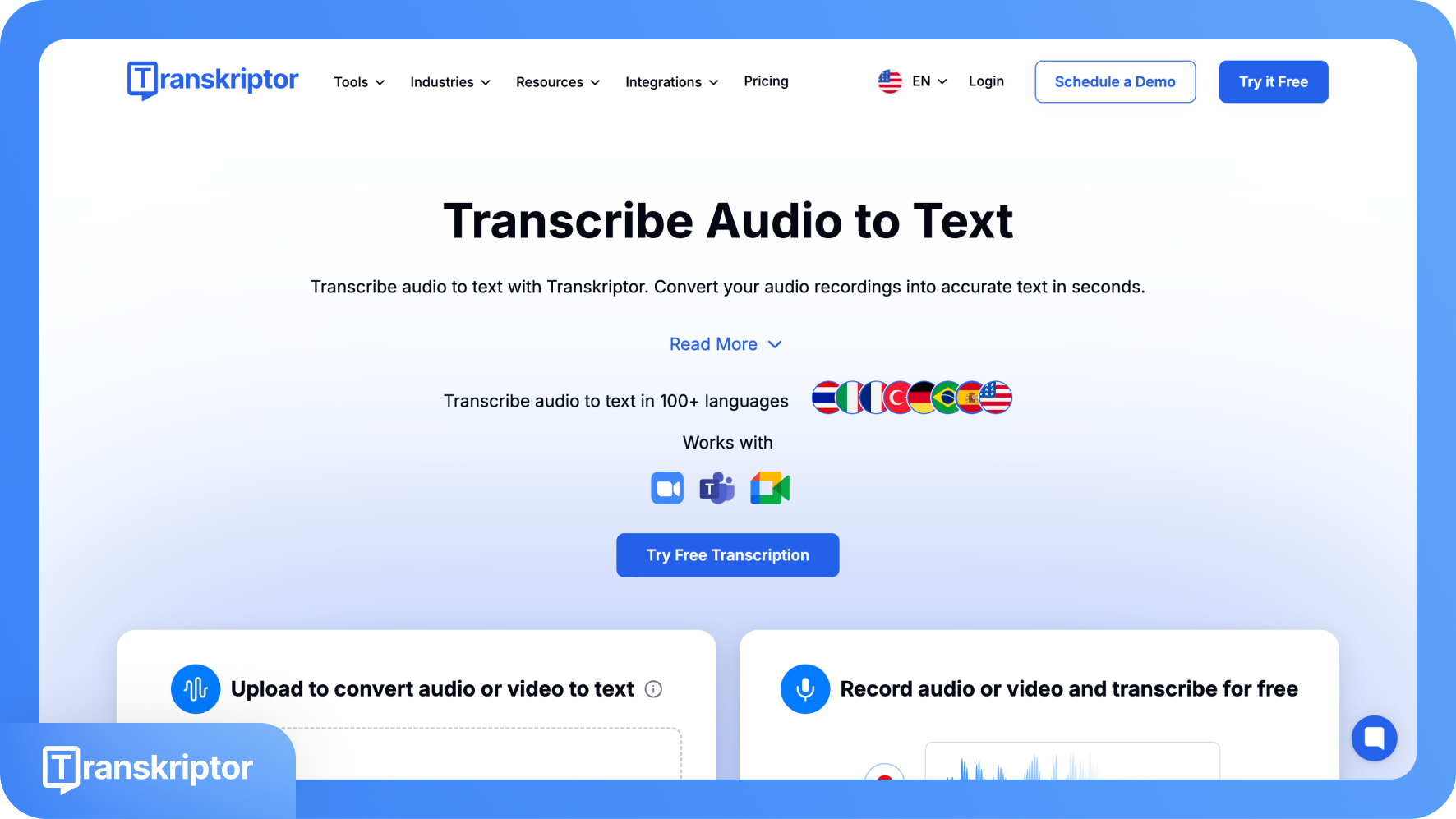
Transkriptor is a strong alternative to Notta, designed for teams that need transcription beyond just meetings. It supports uploaded files, YouTube links, and live sessions with up to 99% accuracy across 100+ languages. Plans start at $9.99 per month, offering a reliable and flexible solution for everyday transcription needs.
Fireflies.ai
Fireflies is the ideal choice for teams that want fully automated meeting capture with minimal setup. The free plan includes unlimited transcription with 800 minutes of storage, while 200+ native integrations automatically send meeting data to CRMs and project management tools after every call.
Otter.ai
Otter.ai is a strong alternative to Notta for teams that need live transcription visible to all participants during meetings. Its Business plan includes 6,000 minutes per user each month, making it a practical option for teams with heavy daily meeting schedules and real-time collaboration needs.
Rev
Rev is the enterprise-grade accuracy option for teams where AI transcription alone cannot meet the required precision standard. Its human transcription service delivers 99%+ accuracy with professional review on every word. This makes Rev the right choice for legal documentation, journalism, and compliance recordings.