
Top 7 Deep Work Techniques to Maximize Productivity


Transcribe, Translate & Summarize in Seconds
Deep work techniques transform productivity by enabling professionals to focus without distraction on cognitively demanding tasks. Implementing effective deep work methods allows knowledge workers to achieve higher-quality outputs while reducing the time required to complete complex projects. The growing challenge of maintaining concentration in a distraction-filled environment makes mastering deep work strategies increasingly valuable for professionals seeking meaningful results.
Below are seven proven techniques that can help you develop and maintain deep work habits for enhanced productivity and performance:
Time Blocking Method : Schedule uninterrupted blocks for cognitively demanding work.
The Pomodoro Technique (Enhanced) : Adjust work/break intervals to match your attention span.
Create a Distraction-Free Environment : Optimize your physical and digital spaces for focus.
Use 90-Minute Focus Blocks : Align your work sessions with your brain’s natural energy cycles.
Develop Deep Work Rituals : Build routines that signal your brain it’s time to focus.
Capture Ideas with Strategic Knowledge Documentation : Record insights without breaking flow—use tools like Transkriptor.
Measure and Improve Deep Work Performance : Track focus metrics to optimize your deep work sessions.
What Is the Science Behind Deep Work Techniques?
The concept of deep work, popularized by Cal Newport in his book "Deep Work: Rules for Focused Success in a Distracted World, refers to the ability to focus without distraction on cognitively demanding tasks. Cal Newport's deep work strategies emphasize the importance of deep work vs shallow work in achieving meaningful results. This state of heightened concentration allows you to master complex information and produce better results in less time. The science behind deep work is compelling—our brains are not designed for constant task-switching, which neurological research shows can reduce productivity by up to 40%.
When you engage in deep work, you're leveraging your brain's neural networks to form new connections and strengthen existing ones. This process, known as myelination, improves your ability to process complex information and solve difficult problems. The contrast between deep and shallow work becomes evident in your output quality and satisfaction.
What Are the Cognitive Benefits of Deep Work?
Enhanced ability to learn difficult concepts quickly
Improved quality of work output
Reduced time needed to complete complex tasks
A greater sense of satisfaction and meaning in your work
Strengthened neural pathways that support critical thinking
What Are the Best Deep Work Techniques?
The ability to perform deep work doesn't come naturally in today's distraction-filled environment. Understanding how to achieve deep work requires deliberate techniques and consistent practice, especially for focus techniques for knowledge workers who face constant interruptions.

Time Blocking Method
Time blocking for productivity is a scheduling method where you divide your workday into blocks of time, each dedicated to accomplishing a specific task or group of tasks. Rather than keeping an open-ended to-do list, you assign each task to a specific time slot on your calendar. This technique, favored by productivity experts like Cal Newport and Elon Musk, transforms your calendar into a time puzzle with zero gaps.
When applied to deep work, time blocking becomes particularly powerful because it creates a psychological commitment to focused work. By assigning specific hours to deep work activities, you're less likely to allow distractions to derail your focus.
Implementation steps:
Schedule 2-4 hour blocks for your most cognitively demanding tasks
Place these blocks during your peak mental performance hours
Buffer these sessions with preparation and review periods
Defend these time blocks as you would important meetings
Adjust your blocks based on energy levels and actual completion times
The Pomodoro Technique
The traditional Pomodoro Technique involves working in focused 25-minute intervals separated by 5-minute breaks, with a longer break after completing four intervals. While effective for many tasks, deep work often requires modifications to this approach to accommodate the unique demands of complex cognitive activities.
The enhanced Pomodoro method for deep work adjusts the intervals to better match your cognitive rhythms and the nature of the task at hand. Instead of rigid 25-minute blocks, you might extend focus periods to 50 or even 90 minutes for truly demanding work, followed by proportionally longer breaks to support recovery.
How to customize Pomodoro intervals:
Start with traditional intervals (25/5) to build the habit
Gradually extend work intervals to 50-90 minutes for deep work tasks
Lengthen break periods to 10-15 minutes after extended focus sessions
Use a timer app or physical timer to maintain discipline
Track your optimal interval patterns for different types of deep work

Creating a Distraction-Free Environment
Your environment plays a crucial role in your ability to achieve and maintain deep work states. Physical and digital distractions can derail your concentration and significantly increase the time required to return to a focused state. Creating spaces—both physical and digital—that signal to your brain it's time for serious work is essential for sustained deep work.
The principles of digital minimalism can be particularly helpful in designing a work environment conducive to deep focus. By removing unnecessary digital tools and streamlining your workspace, you reduce the cognitive load associated with constant decision-making about where to direct your attention.
Physical space optimization:
Designate a specific area used exclusively for deep work
Remove or hide physical distractions from your workspace
Use noise-canceling headphones or ambient background sounds
Ensure proper lighting and ergonomic comfort
Display visual cues that trigger your deep work mindset
Digital environment strategies:
Turn off all notifications during deep work sessions
Use website blockers like Freedom or Cold Turkey
Close email and messaging applications
Implement a "shutdown complete" ritual at the end of each day
Create separate user profiles for deep work vs. shallow work
Practice eliminating distractions for focus by removing digital temptations
The 90-Minute Focus Block
The 90-minute focus block technique is based on research into ultradian rhythms—natural cycles of energy and fatigue that occur throughout the day. Scientists have discovered that our brains naturally operate in roughly 90-minute cycles of higher and lower alertness. By aligning your deep work sessions with these natural rhythms, you can optimize your cognitive performance.
This method involves working intensely for approximately 90 minutes, then taking a significant break of 15-30 minutes before beginning another deep work session. Unlike shorter intervals in the Pomodoro method, the 90-minute block allows you to reach deeper states of focus and achieve flow, that state of complete immersion in a task where time seems to disappear.
Implementing 90-minute deep work blocks:
Schedule 2-3 blocks per day, separated by recovery periods
Begin each block with a clear, written objective
Start with your most important cognitive tasks
Use the first few minutes to ramp up focus gradually
End each block by documenting progress and next steps
Recovery period optimization:
Move physically—take a walk or do light stretching
Hydrate and have a light nutritional snack
Avoid digital devices during breaks
Practice brief meditation or deep breathing
Review your progress and set intentions for the next block
Deep Work Rituals and Routines
Consistent rituals and routines serve as powerful triggers for your brain to enter focused states more quickly. When you establish specific patterns before deep work, these actions become associated with concentration, making it easier to transition into productive states. Top performers across domains—from writers to athletes to programmers—often rely on personalized routines to signal to their minds that it's time for serious work.
The most effective deep work rituals combine physical, environmental, and mental preparation elements. By designing a routine that addresses potential distractions and primes your mind for focus, you reduce the activation energy required to start difficult cognitive tasks.
Sample deep work rituals:
Clear your workspace of all unrelated materials
Write down your specific objectives for the session
Set a timer or define a clear endpoint
Perform a brief mindfulness exercise to clear mental clutter
Use specific music, sounds, or silence to trigger focus
Prepare all necessary resources before beginning
Personalizing routines:
Experiment with morning vs. afternoon deep work sessions
Track which environmental factors most affect your focus
Adjust ritual complexity based on task difficulty
Incorporate physical movement if it enhances your concentration
Create different routines for different types of deep work
Strategic Knowledge Documentation
One of the biggest challenges in deep work is capturing valuable insights without breaking your flow state, a task often simplified when you transcribe audio. Traditional note-taking can disrupt your concentration, yet failing to document key thoughts often leads to lost insights. Strategic knowledge documentation involves using tools and techniques that allow you to capture ideas, such as when you dictate text, with minimal disruption to your cognitive process.
Voice recording represents a particularly valuable method for documenting thoughts during deep work sessions. By speaking your insights aloud rather than typing them, you can maintain your train of thought while creating a record of your thinking. This is where Transkriptor can dramatically enhance your deep work process.
Voice recording strategies during deep work:
Keep a dedicated recording device or app ready
Schedule brief documentation breaks within focus sessions
Speak insights aloud as they occur, without stopping your work
Create verbal bookmarks that highlight particularly important ideas
Review and organize recorded insights during recovery periods
How Transkriptor enhances knowledge capture:
Automatically converts your spoken thoughts into searchable text
Supports 100+ languages for multilingual professionals
Creates AI-powered summaries of your recorded insights
Offers built-in organization tools for categorizing thoughts
Allows easy sharing of transcribed insights with collaborators
Provides a complete historical record of your deep work sessions
Measuring and Improving Deep Work Performance
What gets measured gets improved. Tracking the quantity and quality of your deep work sessions provides valuable data for optimizing your approach over time. By establishing metrics that matter for your specific type of cognitive work, you can identify patterns, remove obstacles, and progressively increase your capacity for sustained concentration.
Effective measurement goes beyond simply logging hours—it involves assessing both the process and outcomes of your deep work. By tracking various aspects of your focus sessions and correlating them with results, you can develop a personalized framework for maximizing your cognitive performance.
Productivity measurement for deep work:
Total deep work hours per week
Average duration of uninterrupted focus
Complexity level of completed tasks
Subjective quality rating of work output
Recovery time needed between sessions
Flow state frequency and duration
Tools for cognitive performance enhancement and tracking:
Deep work journals (analog or digital)
Time-tracking apps with focus categories
Transkriptor for documenting verbal progress updates
Project management tools with time estimation features
Regular reviews of deep work trends and patterns
What Are the Best Tools for Deep Work?
The right tools can significantly enhance your ability to engage in deep work by removing friction, automating routine tasks, and supporting your cognitive processes. While tools alone can't create the discipline required for deep work, they can amplify your efforts and make sustained focus more achievable in a distraction-prone environment.
When selecting tools to support your deep work practice, prioritize those that simplify your workflow rather than adding complexity. The best productivity tools often fade into the background, allowing you to focus entirely on the substantive work itself.
Audio Documentation Tools
Audio documentation has emerged as a powerful approach for knowledge workers seeking to capture insights without disrupting their flow state. Speaking thoughts aloud while working allows you to maintain concentration on complex problems while creating a record of your thinking process. This approach is particularly valuable during breakthrough moments when stopping to type notes would break your creative momentum.
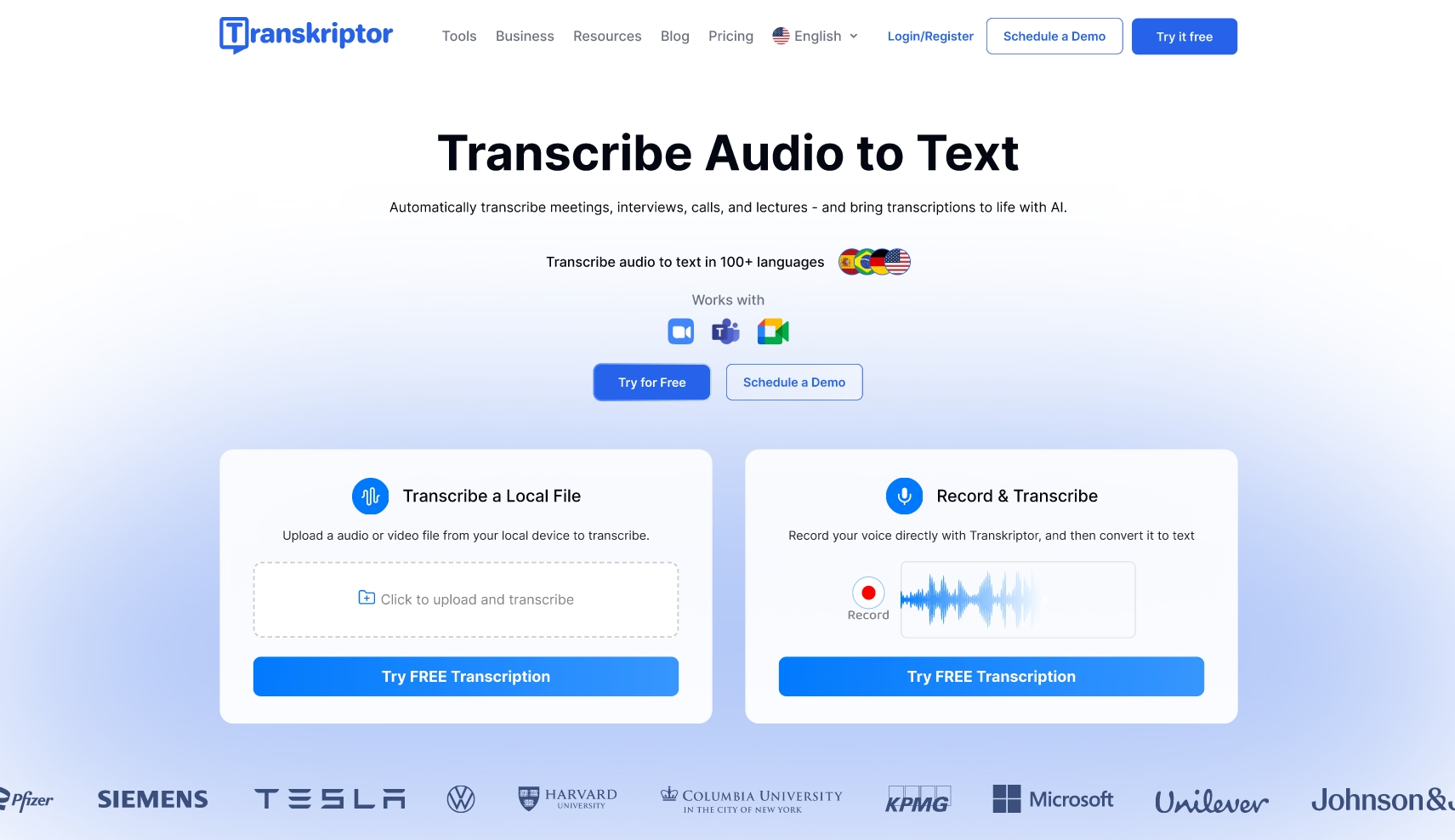
Transkriptor stands out as an exceptional transcription tool for supporting deep work through its advanced audio-to-text capabilities. Additionally, learning how to add subtitles in iMovie can enhance the accessibility of your video content. Automatically converting your spoken thoughts into searchable, editable text bridges the gap between uninterrupted focus and comprehensive documentation.
Importance of voice recording for deep work sessions:
Maintains cognitive momentum during breakthrough thinking
Captures nuanced thoughts that might be lost when typing
Allows for more natural expression of complex ideas
Creates a complete record of your thinking process
Supports later reflection and pattern recognition
How Transkriptor supports deep work:
Converts spoken insights into accurate, editable text
Supports 100+ languages for global professionals
Provides AI-powered summaries of lengthy recordings
Offers searchable transcripts for easy reference
Identifies key topics and themes automatically
Integrates with popular productivity and collaboration tools
Conclusion
Deep work has become the superpower of the 21st-century knowledge economy. In a world where distraction is the default and shallow work dominates most schedules, the ability to focus intensely on cognitively demanding tasks sets top performers apart. By implementing the seven techniques we've explored—time blocking, enhanced Pomodoro, distraction-free environments, 90-minute focus blocks, personalized rituals, strategic documentation, and performance measurement—you can dramatically increase your capacity for meaningful work.
The journey toward mastering deep work is ongoing and personal. Start by selecting one or two techniques that resonate most strongly with your work style and current challenges. As you build your deep work muscle, incorporate tools like Transkriptor that support your process while minimizing disruptions to your flow state. Remember that the goal isn't perfect focus but rather progressive improvement in your ability to concentrate on what matters most. With practice, patience, and the right supporting tools, you can transform not just your productivity but your experience of work itself.